CITRUS
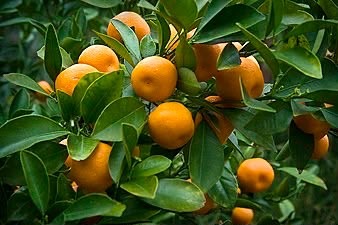
These plants are large shrubs or small to moderate-sized trees, reaching 5–15 m (16–49 ft) tall, with spiny shoots and alternately arranged evergreen leaves with an entire margin. The flowers are solitary or in small corymbs, each flower 2–4 cm (0.79–1.57 in) diameter, with five (rarely four) white petals and numerous stamens; they are often very strongly scented, due to the presence of essential oil glands.
The fruit is a hesperidium, a specialized berry, globose to elongated, 4–30 cm (1.6–11.8 in) long and 4–20 cm (1.6–7.9 in) diameter, with a leathery rind or “peel” called a pericarp. The outermost layer of the pericarp is an “exocarp” called the flavedo, commonly referred to as the zest. The middle layer of the pericarp is the mesocarp, which in citrus fruits consists of the white, spongy “albedo”, or “pith”. The innermost layer of the pericarp is the endocarp. The space inside each segment is a locule filled with juice vesicles, or “pulp”. From the endocarp, string-like “hairs” extend into the locules, which provide nourishment to the fruit as it develops. Citrus cultivars have been developed to be seedless and easy to peel.
Citrus fruits are notable for their fragrance, partly due to flavonoids and limonoids (which in turn are terpenes) contained in the rind, and most are juice-laden. The juice contains a high quantity of citric acid and other organic acids giving them their characteristic sharp flavor.
Key Details
- Evergreen trees, 5–15 m tall
- Strongly scented white flowers
- Fruit: hesperidium with zest, pith and pulp
- Rich in citric acid